Row Level Security: Precise Data Protection in the Database
Discover Row Level Security (RLS). Learn how this mechanism secures database rows and precisely manages user access, including its implementation in Supabase.
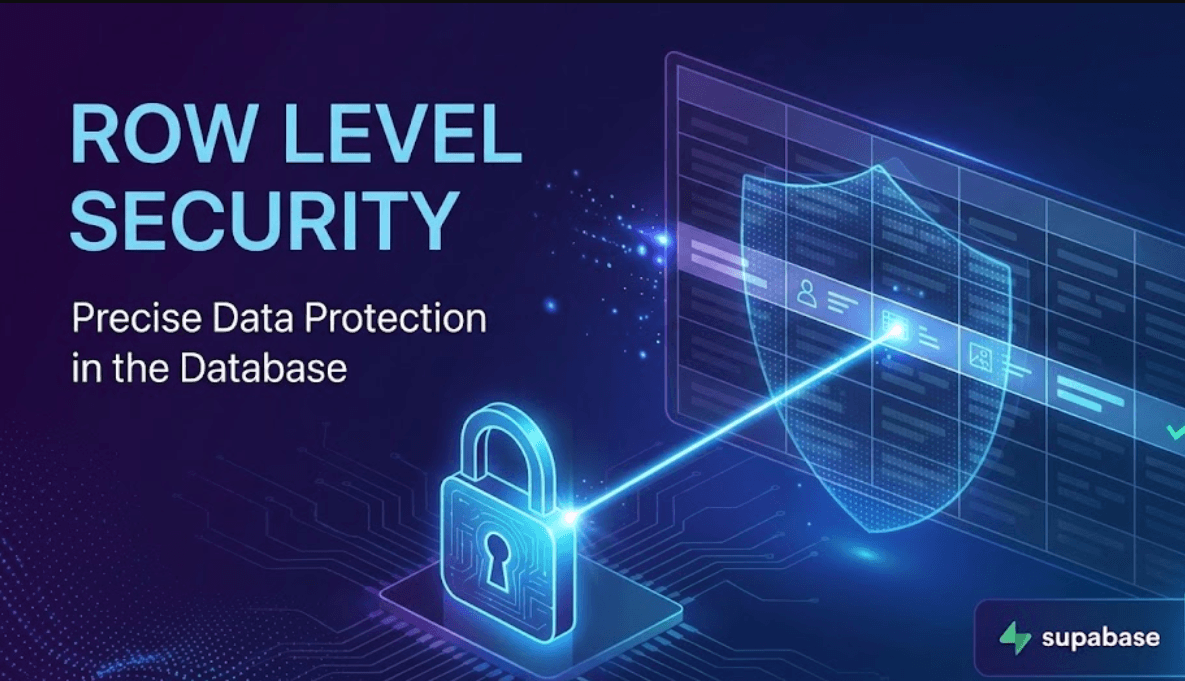
What is Row Level Security?
Row Level Security (RLS) is a security mechanism embedded in modern database engines. It allows for precise definition of who can view or modify specific records within a table. Traditional database security approaches rely on a general permission system. A user typically receives access to an entire table or specific columns. RLS changes this paradigm. It enables data filtering at the single-row level based on the identity of the user executing the query.
This can be compared to a situation in a large office building. Traditional permissions are like an access card allowing entry to a specific floor. Row Level Security is an intelligent system that opens doors only to those specific offices for which the employee has a named authorization.
Discover projects we've created for our clients and see how we can help your business grow.
How the RLS Mechanism Works
RLS operation relies on security policies defined directly within the database. When an application or user sends an SQL query, the database engine intercepts it before execution. The system then checks the defined rules and automatically applies additional filters. This happens completely transparently to the application code.
This process resembles automatically adding a filtering clause to every query. A programmer might write a simple query fetching all data from the orders table. However, the database engine will detect the user's identity and return only those records that belong to them.
Supabase and Row Level Security
Supabase, being an open-source alternative to Firebase built on top of PostgreSQL, treats Row Level Security as a fundamental component of its architecture. Since Supabase allows direct access to the database from the client side (frontend), RLS is the primary barrier protecting data.
In the Supabase ecosystem, RLS is enabled by default and strongly recommended. Developers define policies using SQL, often utilizing helper functions provided by Supabase to verify the currently logged-in user (e.g., auth.uid()).
- Direct Access: It enables secure querying of the database directly from a React, Vue, or mobile application without an intermediary API layer.
- Integration with Auth: Supabase Auth integrates seamlessly with PostgreSQL RLS, meaning authentication context is automatically available within the database policies.
Main Advantages of Using RLS
Moving authorization logic from the application layer to the data layer brings tangible benefits to the project and system security.
- Centralized Security: Access rules are located in one place. This eliminates the risk of programmer error, such as forgetting to add a filter in one of the many queries in the backend code.
- Protection Against Data Leaks: Even if an attacker manages to execute SQL Injection, the RLS mechanism will still block access to rows for which the specific account has no permissions.
- Simplified Multi-tenancy: In multi-tenant systems, RLS drastically simplifies the architecture of separating individual clients' data.
Practical Application
The most common use case for Row Level Security is SaaS applications serving multiple companies simultaneously. All data is often stored in the same tables. Thanks to RLS, developers do not need to worry about manually filtering data with every read operation.
This mechanism also works well in HR systems. All employees might have access to the personal data table, but the RLS policy ensures that a regular employee sees only their record, a manager sees their team's records, and a director gains insight into the entire department's data.
Challenges and Performance
Implementing Row Level Security requires conscious database design. Every query must pass through additional policy verification, which can affect server response time. In the case of highly complex security rules, the computational overhead may become noticeable.
Proper indexing of columns used in RLS policies is crucial. A well-designed database schema ensures that the performance overhead is negligible compared to the gains resulting from the elevated security standard.
Ready to Build Something Amazing?
Let's discuss your next project and bring your ideas to life with cutting-edge technology.
Updated on: January 4, 2026
Related Articles

Everyone Tells You to Build an MVP. Nobody Explains What That Actually Means.
Everyone says "build an MVP", but what does that actually mean for your startup? We break it down without jargon, through a real-world booking app story.

Scroll-based Animations: A New Dimension of Interaction in Web Applications
Scroll-driven animations represent a leading trend in modern web development. This article explores the technical aspects of scrollytelling, discusses the impact of interactive elements on user engagement, and presents the most efficient tools and implementation techniques, including native browser APIs.