Headless CMS vs. Traditional CMS. Which solution should you choose for your project?
Standard CMS platforms impose rigid technological frameworks that hinder application scaling beyond the browser. Headless architecture eliminates these constraints by decoupling the backend from the frontend, enabling content distribution via API to any device. Comparing both models in terms of performance, security, and technical debt simplifies choosing a solution that genuinely supports software architecture rather than limiting it.
The Evolution of Content Management in the Digital World
Selecting the appropriate Content Management System (CMS) is one of the critical technical decisions made before launching a new digital project. For years, monolithic solutions dominated the market, integrating the database, administration panel, and the presentation layer visible to the end-user into a single environment.
With the advancement of technology and the emergence of the need to deliver content across multiple channels simultaneously—such as mobile applications, IoT devices, or smartwatches—the traditional approach became insufficient. The response to these challenges is the Headless CMS architecture, which fundamentally changes how we think about content distribution. Understanding the differences between these two models is essential for making an informed business and technological decision.
Discover projects we've created for our clients and see how we can help your business grow.
What Characterizes a Traditional CMS?
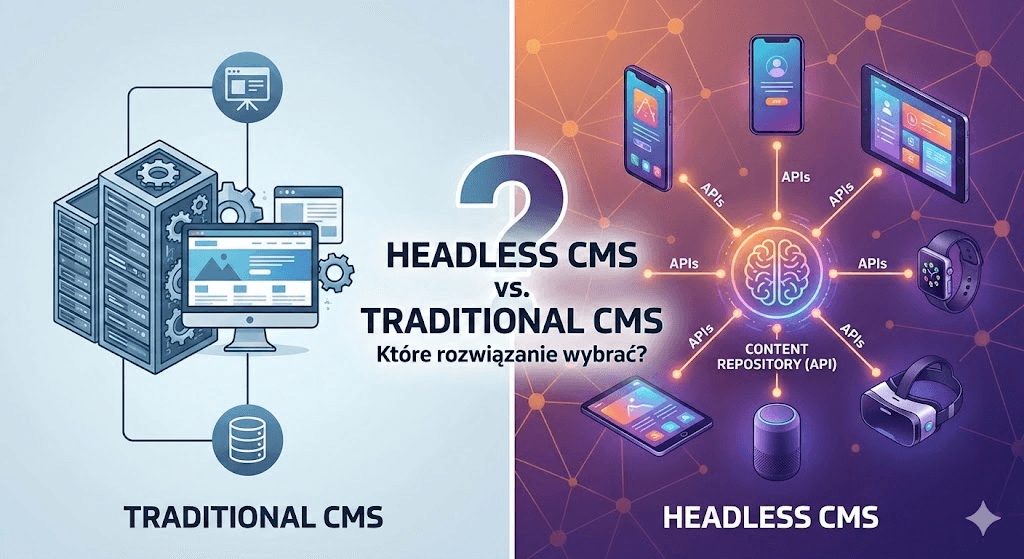
A Traditional CMS, often referred to as a "coupled" system, is an all-in-one solution. In this architecture, the content management system (backend) is tightly linked with the presentation layer (frontend), which is what the user ultimately sees on the website.
In practice, this means that platforms like WordPress or older versions of Drupal manage not only the storage of text and images but are also responsible for generating the HTML and CSS code that displays this content in a browser. Website creators utilize ready-made themes and templates specific to a given platform.
The main advantage of this approach is the simplicity of implementation for standard websites. Marketing teams can independently manage the site's appearance and content without engaging developers for every change. However, the downside is limited technological flexibility and the difficulty of utilizing the same content outside the main website.
What is a Headless CMS?
The Headless CMS approach severs the inseparable bond between content and its presentation. In this architecture, the CMS functions exclusively as a content repository. It does not possess a built-in layer responsible for displaying the website, hence the name "headless."
Communication between the content repository and the external world occurs via an Application Programming Interface (API), most commonly using REST or GraphQL standards. The role of a Headless CMS is to deliver raw data in JSON format to any client application that requests it.
This means that content created once in the administration panel can be simultaneously displayed on a modern website built with React, in a native iOS mobile application, and on a smart home device screen. Each of these platforms possesses its own independent frontend, which merely retrieves data from the central system.
Key Differences in Architecture and Application
The choice between a traditional and a headless CMS comes down to analyzing the specific needs of the project and available development resources. Below are the most important areas where these two approaches differ:
- Architecture and Flexibility: A Traditional CMS dictates the presentation layer technology (e.g., PHP and a specific template engine). A Headless CMS gives developers complete freedom in choosing frontend frameworks (e.g., Vue.js, React, Svelte), allowing for the creation of faster and more interactive user interfaces.
- Omnichannel: Traditional systems are optimized for websites. Using their content in a mobile app often requires creating additional, custom solutions. Headless CMS is designed from the ground up to support multiple channels simultaneously through a universal API.
- Security and Performance: In the Headless model, the presentation layer is physically separated from the database and administration panel. This reduces the attack surface for potential threats. Furthermore, the frontend can be hosted on fast CDN networks, significantly improving page load times.
- Content Creation Process: Traditional systems offer visual WYSIWYG editors, facilitating work for non-technical staff. In Headless systems, previewing content before publication often requires additional configuration by the development team.
When to Choose the Right Solution?
The decision regarding architecture should be dictated by the project's business goals. A Traditional CMS remains an excellent choice for projects where the website is the sole communication channel, and the priority is deployment speed and ease of use for a small editorial team without advanced technical knowledge. It works well for simple corporate sites, blogs, or small online stores.
Headless CMS is the preferred solution for complex digital ecosystems. If a company plans to distribute content across multiple platforms simultaneously (web, mobile, IoT), requires top-tier performance and scalability, and possesses a development team capable of handling modern JavaScript frameworks, the headless architecture will yield significantly greater benefits in the long term. It allows for building future-proof solutions, ready for integration with new, yet-to-exist content distribution channels.
Ready to Build Something Amazing?
Let's discuss your next project and bring your ideas to life with cutting-edge technology.
Updated on: January 4, 2026
Related Articles

Everyone Tells You to Build an MVP. Nobody Explains What That Actually Means.
Everyone says "build an MVP", but what does that actually mean for your startup? We break it down without jargon, through a real-world booking app story.
Row Level Security: Precise Data Protection in the Database
Discover Row Level Security (RLS). Learn how this mechanism secures database rows and precisely manages user access, including its implementation in Supabase.
Scroll-based Animations: A New Dimension of Interaction in Web Applications
Scroll-driven animations represent a leading trend in modern web development. This article explores the technical aspects of scrollytelling, discusses the impact of interactive elements on user engagement, and presents the most efficient tools and implementation techniques, including native browser APIs.